Events
Colloquia, thesis defenses, symposia and departmental events at the Department of Mechanical Engineering.
12 events Clear filters
October 2026
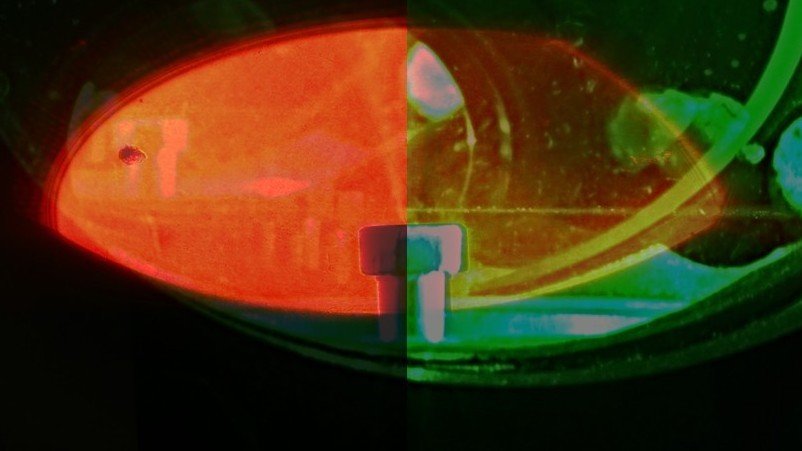
High-spatial-resolution characterization of underexpanded hydrogen jets using spontaneous Raman scattering
The hydrogen jet lies at the foundation of H2 internal combustion engine (ICE) technology, which is why investigation of its characteristics is necessary to advance the implementation and improve the H2 ICE. In this work, spontaneous Raman scattering is used to investigate the temperature, hydrogen number density, and hydrogen mole fraction of a continuous hydrogen jet emanating into atmospheric air. Both vibrational and rotational Raman scattering methods are used to investigate the temperature field of the jet with high spatial resolution, using a spatial sampling interval of 0.1 mm in the axial direction and 0.06 mm in the radial direction. Three different pressure ratios and two different nozzle orifice diameters are studied. Schlieren imaging identifies shock structures within the jet and supports the interpretation of the Raman measurements. The jet is characterized by repetitions of low-to-high-temperature zones in the center of the jet, with increasing temperature at the edges of the jet. The hydrogen number density follows the main temperature structure of the jet, while the hydrogen mole fraction is close to one in the center of the jet, decreasing toward the jet boundary and further downstream due to mixing with the entrained air. Rotational and vibrational Raman measurements show similar overall temperature structures and values. The pressure ratio (nPr) affects both the temperature distribution and size of the jet. The temperature decreases by approximately 50–70 K between nPr = 3 and nPr = 8, while the size of the jet structures increases for nPr = 8. The nozzle diameter mainly affects the spatial dimensions of the jet and its shock structures. A comparison between nozzles shows similar quantitative temperatures along the jet axis, with the only appreciable temperature differences between the nozzles being a 10 K higher minimum temperature for the bigger nozzle size at nPr = 3.
From Natural Language to Executable Models: An LLM-Assisted Pipeline for Powertrain Synthesis
A study on energy dissipation in additively manufactured beams with powder-filled cavities: experimental characterization and modeling directions.
The increasing performance demands of high-performance mechatronic systems require structures that combine low mass, high stiffness, and damping. Additive manufacturing, particularly Laser Powder Bed Fusion (LPBF), enables the integration of powder-filled cavities that can provide passive damping without additional components. However, the underlying energy dissipation mechanism is not yet sufficiently understood. This thesis investigates the modal damping behavior of LPBF-manufactured beam specimens containing powder-filled cavities. Force-amplitude-controlled stepped-sine excitations and frequency response function measurements were used to experimentally characterize the nonlinear, force-amplitude-dependent damping. Specimens with varying cavity heights and positions were investigated. In addition, finite element analysis was performed to determine the strain distribution around the cavities. The experiments showed that damping increases with excitation force amplitude and approaches a constant value at high amplitudes. Cavity position along the beam length was identified as the most influential design parameter, with maximum damping occurring near regions of maximum modal strain. Higher cavities also increased damping by extending into regions of enhanced strain. Comparison with an empty cavity confirmed that the damping originates from the enclosed powder. The results support a friction-based energy dissipation mechanism caused by interactions between powder particles and the cavity walls. Based on these findings, a numerical modeling approach combining FE structural dynamics with friction models such as the Iwan or Jenkins model is proposed.
September 2026
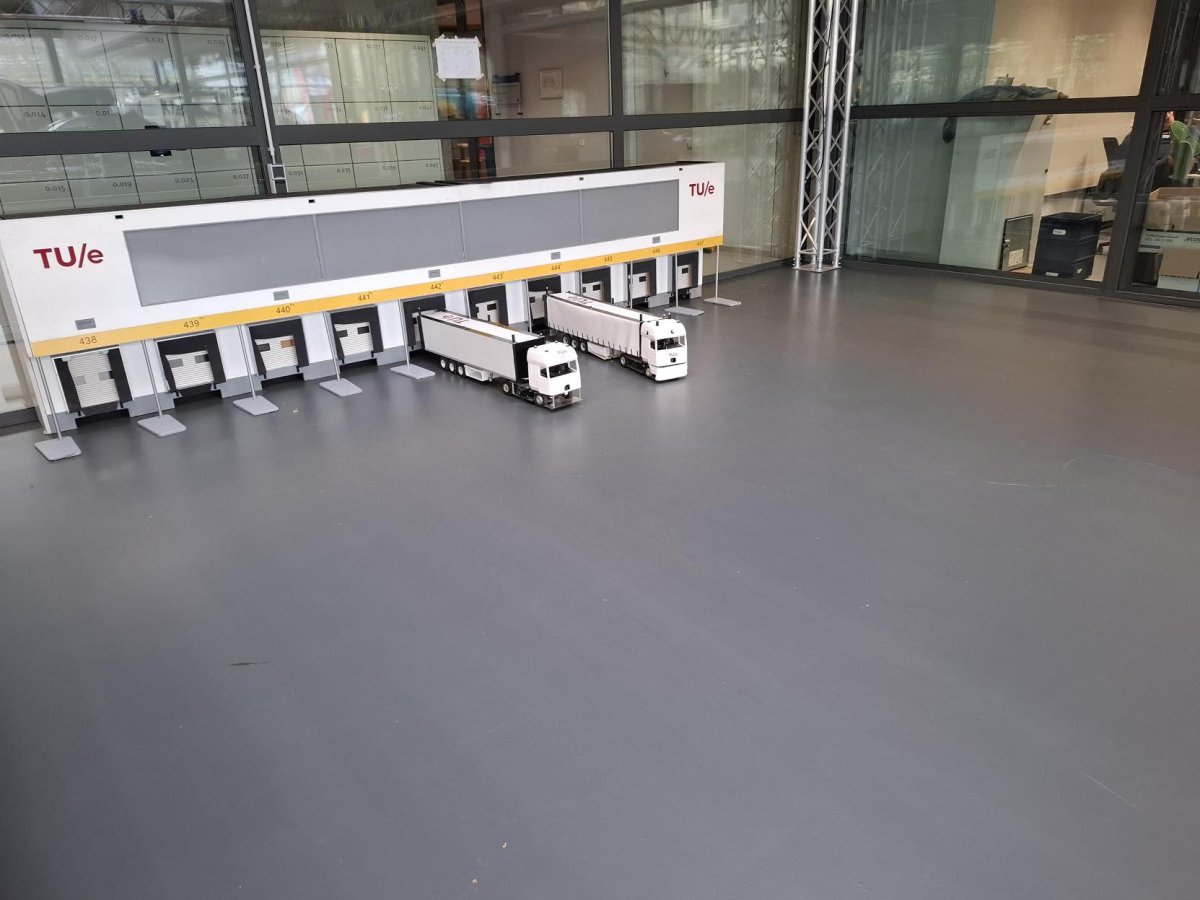
Simulation and Experiment Environment of Truck–Trailer System in Truck Lab
This thesis presents a systematic methodology for the development, validation, and implementation of simulation and experimental environments for a truck and a truck–trailer system based on kinematic vehicle models. The models are validated against experimental measurements obtained from the TU/e TruckLab platform, with identified steering actuator dynamics incorporated to improve the representation of the physical system. Based on these validated models, a simulation environment is developed for controller design and evaluation using predefined straight-line and circular reference trajectories and corresponding tracking-error definition. Following simulation-based verification, the controller can be transferred to the TruckLab experimental platform for experimental evaluation. The performance of different controller designs is evaluated and compared, and their limitations and potential sources of discrepancies between simulation and experiments are discussed. A user guide is also provided to facilitate the use of the developed simulation environment.
Trajectory-Based Co-Design of a GT–SOFC Hybrid Powertrain and Heat Exchanger for Minimizing Fuel Consumption
Additive Fractional Order System Identification
Analysis of a Neuromorphic Controller: A Singularly Perturbed Hybrid Systems approach via Averaging
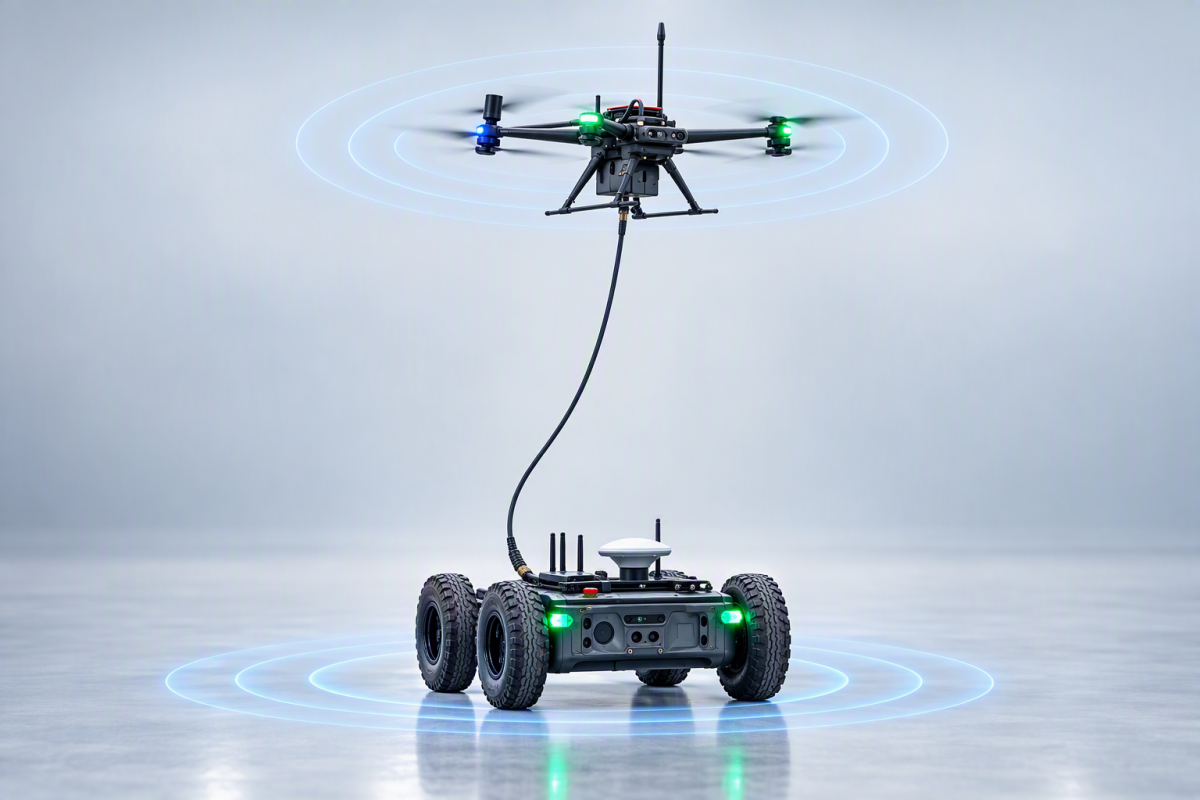
Safe planning for a tethered quadrotor-rover system under parametric uncertainty
Modeling of Electromagnetic Crosstalk in High-Precision Systems

Developing a self-bending kirigami structure driven by liquid crystal elastomers
Liquid crystal elastomers (LCEs) are promising smart materials capable of undergoing large anisotropic deformations in response to external stimuli. When exposed to heat, the material's microstructure transitions from an ordered to an isotropic state, resulting in shrinkage along the director and expansion in the perpendicular directions. Despite their potential, the practical implementation of LCEs remains challenging due to the complexity of predicting their mechanical behavior. This research investigates the design of thermally responsive LCE patches to induce controlled deformation in plastic kirigami structures. Kirigami, a Japanese art form, involves cutting and folding a flat sheet into a three-dimensional shape. The same principle can be applied to plastic foils containing embedded electronics to create deployable or shape-morphing devices. The study begins with the material characterization of both the LCE and the polyethylene naphthalate (PEN) substrate. Based on the obtained material properties, a finite element model of a kirigami structure consisting solely of PEN is developed and validated against experimental results. The resulting strain fields are subsequently used to determine the optimal placement and director orientation of the LCE patches. These patches are then incorporated into the numerical model to predict the resulting deformation and to provide insight into the required patch dimensions. The proposed design workflow enables the systematic determination of the placement, size, and director orientation of LCE patches on kirigami structures and is validated through a physical prototype. Although the prototype exhibited a lower-than-desired deformation, the experimental results showed good agreement with the simulation predictions, demonstrating the effectiveness of the proposed design approach.
Effect of Metallization Degree on Cohesive and Disruptive Forces During Iron Oxide Reduction in Fluidized Beds