Ego Trajectory Prediction for Autonomous Vehicles Using a Dynamics-Residual Hybrid Model
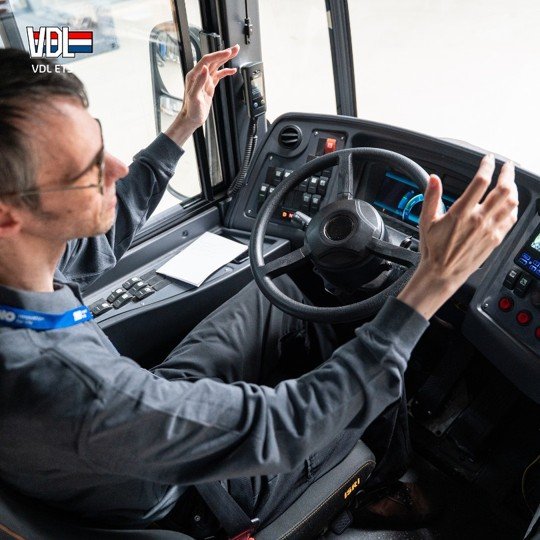
Speaker
Walter Nijhout
About this event
This work presents a hybrid trajectory prediction model for autonomous buses, in a yard-manoeuvring use case (<15 km/h). A hybrid residual model (HM) is used, where an analytical model (AM) is combined with a data-driven model (DM), in this case an LSTM. In this method, the AM provides an initial estimate of the bus's yaw rate and lateral velocity, and a DM learns to correct the residual error of that estimate. A high-fidelity multi-body simulation is used as ground truth for training, where it is excited using a random-phase multisine. The HM's objective function includes both velocities and position, thereby encouraging both physically plausible and accurate trajectories. Additionally, two differing complexities of AMs are used to investigate whether a more complex AM lets the HM predict trajectories more accurately. Over 10 separate training runs, numerical results show that the HM is 94 % more accurate than both baseline AMs in an unseen test-set, and that the different complexities in AMs do not make a significant difference in absolute accuracy. The HM using the more complex AM is found to have larger training-validation gap compared to the HM with the less complex AM.
Host