
The Impact of Numerical Resolution on the Accuracy of 2D Irregular Cell Detonation Simulations
Speaker
Max Hanssen
About this event
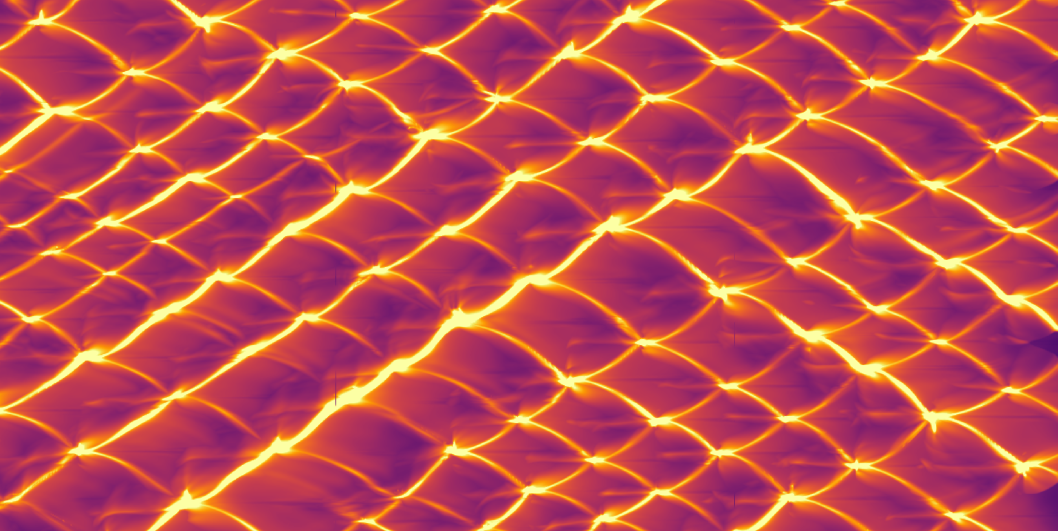
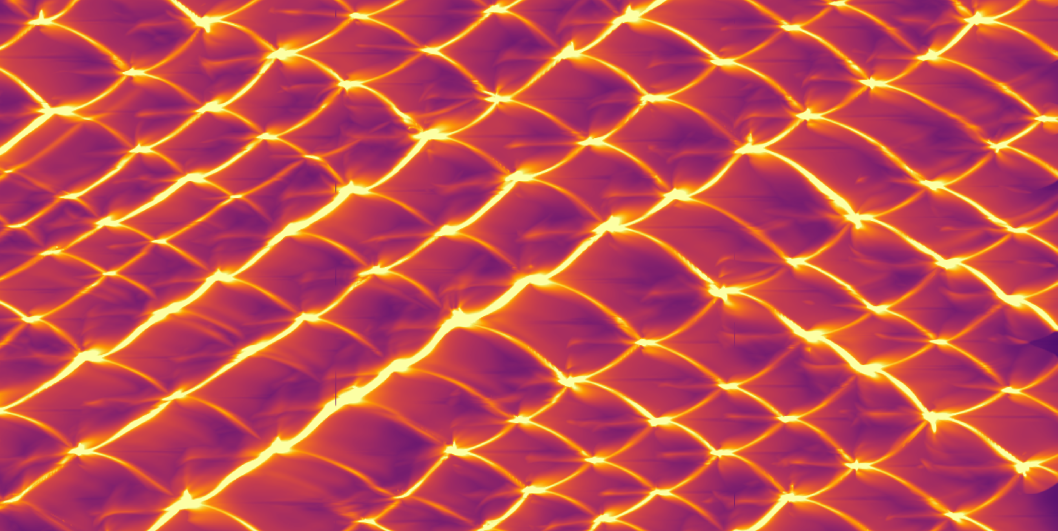
This study investigates the effect of resolution on detonation dynamics in numerical simulations. One- and two-dimensional (1D and 2D) simulations were performed for resolutions between 10 and 300 grid points per ZND induction-zone length for undiluted and diluted stoichiometric mixtures of methane-oxygen and hydrogen-oxygen. Specific properties observed include cell irregularity (measured using the standard deviation of cell angle), average cell size, detonation speed, the induction zone in 1D, and a characteristic length scale in the streamwise direction in 2D simulations. The standard deviation of cell angle shows that when increasing resolution there is a sudden transition to irregularity. However, this transition can occur at different resolutions for different mixtures. Detonation speed stays largely constant, although there is a slight decreasing trend with increasing resolution. 1D simulations show that the distance between the leading shock and the maximum heat release gradient increases with resolution up to 80 grid points per induction-zone length, where it converges at a value close to the ZND induction-zone length. For the 2D methane-air simulations, it was observed that low resolution smears out the shock and reaction zone. This leads to the temperature artificially increasing earlier than expected, leading to a sooner rapid heat release. A too-low resolution can even suppress transverse waves and cellular structures entirely. Unburnt pockets and irregularity are observed at 80 grid points per induction-zone length, and a resolution of 300 grid points per induction-zone length shows more precise vortices and small-scale effects. It has been concluded that capturing the global behavior of irregular-cell detonations requires at least 40-80 grid points per ZND induction-zone length (depending on the mixture).