Shape Optimization of Ducted Wind Turbines Using CFD-Based Surrogate Modelling
Speaker
Marten Meerburg
About this event
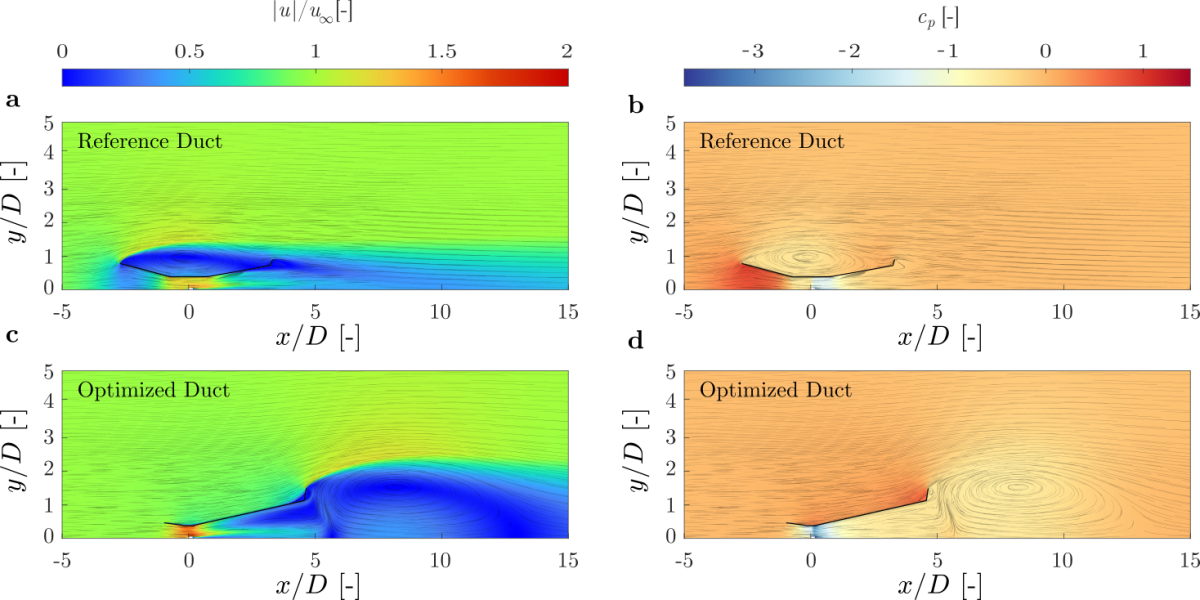
Urban wind energy generates electricity close to where it is used and offers a promising way to both reduce transmission losses and relieve congested energy grids. Urban wind speeds are typically low, however, which keeps wind turbines below their cut-in speed. Placing a duct around the turbine can locally accelerate the flow and thereby increase the power output, but this performance gain depends strongly on the shape of the duct. This study therefore aims to optimize the duct shape of a stand-alone wind turbine to maximize its power output. To achieve this, the study uses the principles of machine learning to build a Kriging surrogate that, once trained, is used (i) to accurately predict the power coefficient $C_P$ of any untested duct shape, (ii) to discover the aerodynamic mechanisms that govern duct performance and the interlinked effect of the geometric parameters on the power output, and (iii) to optimize the duct geometry and explore high-performing designs. The duct geometry consists of a nozzle, throat, diffuser and flange and is described by seven geometric parameters. The rotor is modelled as an actuator disk with the blade loading computed using blade element momentum theory and is included in the simulation-optimization loop. The design space is sampled with 490 computational fluid dynamics simulations, which are validated against wind tunnel measurements. Of these samples, 350 are space-filling samples generated using design of experiments and 140 are generated by adaptive sampling, which refines the model in promising regions. A genetic algorithm is used to search the response surface for optimal designs based on various objectives. The trained surrogate can predict new designs within a root-mean-square error of $7.8\%$ of the range of $C_P$ over the full sample pool. This error decreases to $4.0\%$ in the high $C_P$ regions. Within geometric bounds that limit the duct length to 10\,m, the optimized duct reaches a $C_P$ of $1.858$, which is 4.8 times that of a bare turbine and 3.1 times the Betz limit, a value that is possible because $C_P$ is normalized with the rotor swept area. The high performance originates from the flow entering the duct cleanly, which prevents the formation of low-pressure recirculation zones near the inlet that would otherwise divert the wind around the duct. The flow remains attached through the nozzle, throat and diffuser and separates only at the flange at the downstream end, forming a low-pressure wake behind the duct. This low-pressure region downstream helps to draw more air through the duct and therefore generate more power from the wind.
Host