Motion and Vibration Control of a Robot on a Compliant Support
Speaker
Bart Bergers
About this event
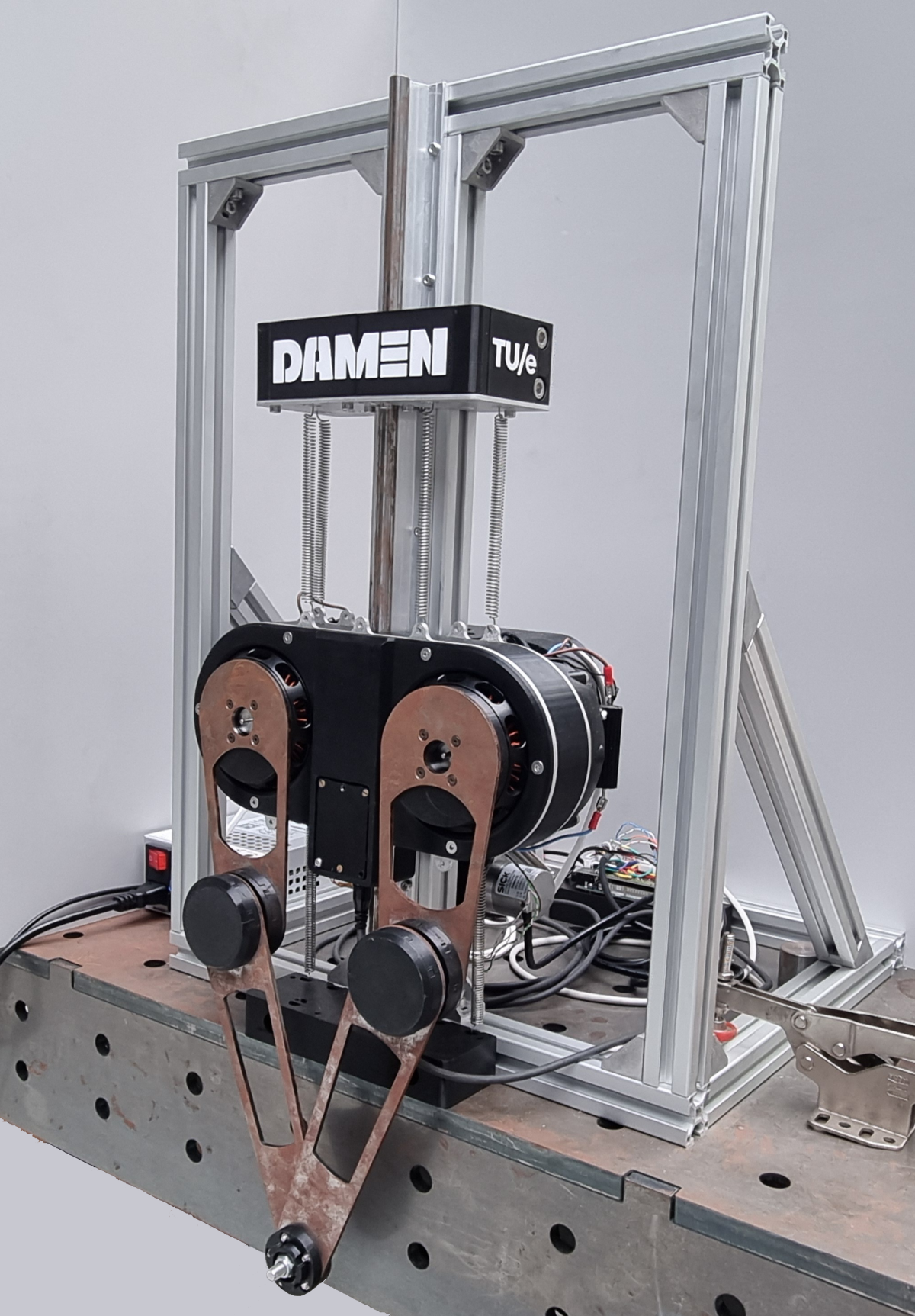
This thesis investigates control strategies for improving the accuracy of a welding robot mounted on a compliant support. The research is motivated by robotic welding applications in shipbuilding, where in the future robots can be positioned using boom-like structures. Vibration and movement of the support structure can however compromise welding accuracy. To study this problem, a five-bar robot with a single vertical compliant degree of freedom was developed as an experimental setup. Analytical modelling, multibody simulation, and physical experiments were used to examine the influence of mechanism mass, support stiffness, and trajectory duration. In this way, four control strategies were evaluated: encoder-based base-motion compensation, IMU-based acceleration feedforward, zero-vibration input shaping, and zero-delay input shaping. The results show that structural compliance increases world-frame tracking error, particularly when the commanded motion excites the dominant structural mode. Encoder-based compensation provides the most consistent improvement, while acceleration feedforward has a limited effect. Input shaping reduces vibration at the cost of increased movement time, whereas zero-delay input shaping preserved the original duration but is sensitive to operating conditions. Overall, the results show that tracking accuracy can be improved using the robot’s existing actuators, although the achievable improvement depends on the system dynamics, trajectory, control delay and sensors.
Host