Development of Sintered Tungsten Wicking Architectures for Lithium Heat Pipes under Fusion-Relevant Divertor Heat Fluxes
Speaker
Max Voncken
About this event
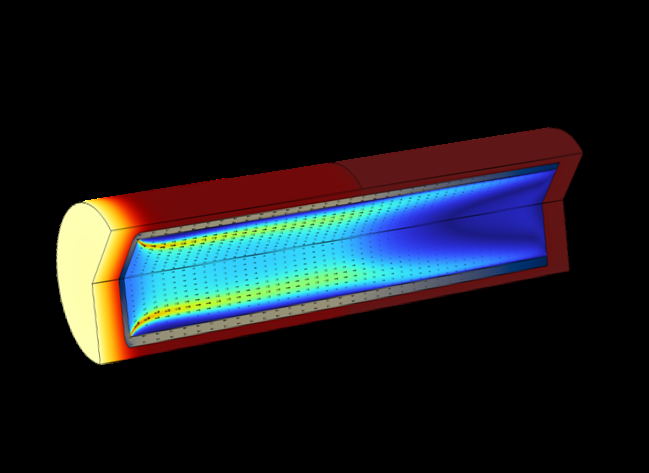
Nuclear fusion represents a promising route towards low-carbon, high-density energy production. The development of magnetic-confinement fusion devices, however, requires plasma-facing components (PFCs) capable of withstanding severe thermal loads within the divertor region. These thermal loads consist of steady-state heat fluxes exceeding 10MWm^(-2). High-temperature liquid-metal heat pipes are being investigated as a novel approach for managing such loads by redistributing highly localized surface heat fluxes over a larger area for subsequent heat rejection. The heat pipe concept currently considered for this approach consists of a tungsten envelope and wick, with liquid lithium as the working fluid. For the heat pipes concerning this application, the capillary wick represents a critical component. It must simultaneously provide sufficient capillary pressure for liquid return and sufficiently low hydraulic resistance to sustain the required mass flow. The design of a tungsten wick is currently limited by the sparse amount of commercially available porous tungsten materials, and the lack of literature on the transport properties of porous tungsten. The limited availability of porous tungsten has resulted in the start of a material synthesis program. The aim of this program is to develop the manufacturing process needed for the production of porous tungsten with favorable transport properties for heat pipe applications. Additionally, traditional analytical design equations that are used to design heat pipes are not directly transferable to the current system due to the unique heat load application on this heat pipe. This thesis supports the material synthesis program through the development of a forced-flow and capillary-rise measurement setup, enabling the characterization of the transport properties of synthesized porous materials. Subsequently, mercury intrusion porosimetry is performed on synthesized tungsten to guide the ongoing material synthesis that is conducted in parallel with this work at a collaborating institute. Second, the applicability of the heat pipe design equations to the present concept is investigated through the use of a single phase numerical model adopted from the literature. Following this numerical verification, the design equations are employed to identify the porous transport properties that are necessary to sustain heat loads up to 20MWm^(-2)using a homogeneous annular wick. From this analysis, the critical heat pipe performance limit is identified, and a composite wicking architecture is proposed to overcome the identified limitation. Through a modified set of design equations and numerical verification, the ability of this proposed architecture to overcome the performance limitation and its influence on porous transport property demands is evaluated. Ultimately, by bridging the gap between measured transport properties and theoretical requirements, this work provides the material development program with targeted specifications for the next generation of powders.
Host