A Discrete Multibody Model for the Locomotion and Interaction of Cilia-Bots
Speaker
Ruben Vreugdenhil
About this event
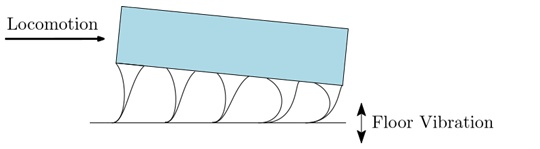
Artificial cilia-bots can move across a vibrating surface through the bending of flexible legs. Their motion depends on how the legs buckle, carry the body weight and interact with the surface through friction. These coupled effects can produce sustained travel or changes in direction, but make it difficult to predict how changes to the bot will affect its motion. This thesis develops a planar model to investigate these mechanisms. Hencky-type discrete legs are coupled to rigid bodies and frictional contact in Cardillo. Nonsmooth time stepping combines large leg deformations with impacts, sticking and sliding. Beam and rigid-body contact benchmarks check the model components, while compression and lateral dragging tests compare the simulated cilium response with published experiments. The model reproduces the main deformation and contact trends, although quantitative force agreement remains limited. Compression measurements after settling holds follow the broad continuous-loading response, while buckling and bending reversal retain dynamic force peaks. The simulations show that net travel depends on the leg-bending pattern and the persistence of motion in one direction. Friction, stiffness and damping can change this motion pattern, and reversals can cancel much of the displacement. In the multi-leg studies, initial preparation and support placement affect how the legs bend and share load. Spreading the supports outward generally reduces body pitch and improves travel in the tested four-leg configurations, but lower pitch alone does not explain locomotion across different layouts. Contact with walls or other bots can change leg bending and produce sustained reversal. The model provides a means to examine how deformation and contact produce locomotion and to compare design choices under controlled conditions. Timestep checks show that averaged motion can become similar under refinement while reversal timing and net displacement remain sensitive. Its present contribution is therefore the study of these mechanical relationships; quantitative prediction of the full experimental walker requires further validation under matched conditions.
Host