
Events
Colloquia, thesis defenses, symposia and departmental events at the Department of Mechanical Engineering.
13 events Clear filters
November 2026

From Mind to Matter
The human hand is one of nature’s most complex and versatile structures, enabling the unmatched ability to manipulate and sense the surrounding world. The capability to interact with the world with precision and strength have empowered people to create anything from art to technology, making the loss of hands through injury, disease, and congenital conditions a significant for a challenge in a society that is built around them. While recent advances in prosthetic hardware design have emphasised accessibility, open-source solutions, and ease of adoption, current devices remain far less capable than the human hand. With the ultimate goal of designing functional integrated neuro-prosthetics, the next vital stepping stone needed is a focus on adaptivity, where the hard- and software are designed to be able to handle and learn from any scenario that a person finds themselves in. In this dissertation, I address the needed step towards adaptive prosthetics using both passive and active adaptive approaches. For passive adaptivity, an anthropomorphic hand is designed using soft robotics due to their inherent flexibility and shape conformity. However, where soft actuators have unparalleled shape conformity due to this flexibility, this comes at a sacrifice to their strength. To ensure that these soft actuators can be used to achieve a stable grasp on objects of varying weights, several manufacturing techniques were developed to integrate the actuators with rigid components to constrain degrees of freedom, improving force transmission. For active adaptivity, the prosthetic hand is outfitted with an organic neuromorphic circuit and temperature sensors. This neuromorphic circuit, inspired by the function of the human temperature reflex, uses organic transistors to respond to temperature stimuli, and adjusting its sensitivity automatically based on its experiences after integrating it into a traditional feedback control loop on the prosthetic hand. This proof-of-principle hand shows the strengths of a multidisciplinary approach to adaptive gripping, resulting in a system that aligns closer with the capabilities of the human hand than before.

A physics-based model order reduction framework for nonlinear contact problems
In many engineering applications, Finite Element (FE) models are vital for simulating real-world phenomena. However, resolving complex geometries or capturing nonlinear behaviour often makes these FE models computationally expensive. This challenge is particularly critical in scenarios that require repeated simulations, such as design optimisation, parametric studies, or uncertainty quantification. In cases such as digital twin applications, near-real-time simulations are needed, further increasing the computational burden. Model Order Reduction (MOR) techniques aim to address these challenges by reducing the dimensionality of the original Full Order Model (FOM), thereby producing a Reduced Order Model (ROM) that is significantly smaller and computationally more efficient, while retaining the core physics of the FOM. Most conventional MOR techniques are data-driven. The most widely used among them, Proper Orthogonal Decomposition (POD), depends on the simulation data of the very FOM it seeks to reduce. While effective for interpolation within the well-sampled parameter space, POD is generally unreliable for extrapolation to unseen parameter ranges. As an alternative, the primary objective of this thesis is to develop a physics-based MOR framework that does not rely on any training data. The proposed approach utilises Modal Derivatives (MDs), which are the first-order derivatives of vibration modes, and has been demonstrated to capture nonlinear behaviour within a reduced-order basis. In this thesis, this framework is adapted to address quasi-static geometrically nonlinear solid mechanics and unilateral finite deformation contact problems. Initially, in Chapter 2, the concept of MDs is explained in detail and applied to quasi-static geometrically nonlinear problems. To ensure an orthogonal projection and, in turn, numerical stability of the reduction, these MDs are orthogonalised using the modified Gram-Schmidt process. An online greedy selection is then employed to identify the most significant orthogonalised MDs, achieving an efficient reduction. This approach is validated through various test cases, demonstrating its validity and effectiveness in different scenarios. Chapter 3 extends this framework to handle unilateral finite deformation contact problems where contact constraints are enforced using the Lagrange multipliers. In addition to the orthogonalisation and greedy basis selection strategies introduced earlier in Chapter 2, an exclusion domain is introduced, based on the location of maximum shear stress from Hertzian Contact theory. Within this exclusion domain, the displacement degrees of freedom, along with the Lagrange multipliers enforcing the contact constraints, are maintained at full FE resolution. In contrast, the remaining displacement degrees of freedom are reduced using the earlier framework. This hybrid, MD-based strategy performs well across various unilateral benchmark contact problems, highlighting the effectiveness of the chosen approach. Although the techniques established in Chapters 2 and 3 achieve reduced dimensionality, the resulting improvements in simulation time remain modest. The principal challenge is that, despite reducing the primary variable (displacement), computing the tangent stiffness matrix still requires integration over the entire FE mesh. This integration step remains a significant bottleneck in reducing nonlinear FE problems. To overcome this and accelerate simulations, the developed MOR techniques are combined with a hyper-reduction strategy. Specifically, Energy Conserving Sampling and Weighing (ECSW) is employed, which selects a subset of elements for integration, allowing for the efficient computation of reduced quantities. This combined approach is tested in the next chapter through a Bayesian inference case study, which requires multiple simulations and serves as an ideal validation for the MOR framework enhanced with hyper-reduction. In this context, two quasi-static, geometrically nonlinear problems from Chapter 2 are utilised, providing uncertainty quantification with significantly faster runtimes. In the penultimate chapter of the thesis, all the developed tools are integrated to achieve hyper-reduction of unilateral finite deformation frictional contact problems. Coulomb friction is incorporated into the contact formulation established in Chapter 3. The ECSW hyper-reduction technique is adapted accordingly to include the exclusion zone defined for reducing contact problems. Two examples are considered: first, one of the benchmark problems used in Chapter 3 is revisited to validate this improved framework. Then, a more complex 3D case involving the movement of a catheter inside a soft-tissue-like arterial tube is examined. The results show that the proposed physics-based model order reduction, combined with ECSW, can effectively capture complex, nonlinear, and contact phenomena with considerably lower computational cost, making it a promising tool for large-scale simulations in computational mechanics. Overall, the results presented in this thesis demonstrate the potential of a fully physics-based model order reduction framework, combined with ECSW hyper-reduction, to efficiently simulate non-linear contact FE problems. By eliminating reliance on training data, the developed methods based on MDs achieve substantial computational savings while preserving critical mechanical responses. The successful application to both benchmark and complex use cases underscores the robustness and versatility of the approach, making it a promising tool for faster simulation responses.

Actuation & Sensing Modules for Standardized Organ-on-Chip Platforms
Organ-on-chip (OoC) platforms are advanced cell culture systems that can emulate human tissues and diseases for mechanistic studies, potentially conducive to improved drug development and personalized therapy guidance. These platforms provide a representative tissue microenvironment including microfluidic perfusion and controlled mechanical stimulation to synthetically replicate in vivo-like conditions that static in vitro models cannot provide. This is particularly relevant for barrier tissues, where function is tied directly to flow, transport dynamics, and integrity of cell layers. Translating OoC technology into routine laboratory practice requires platforms that are not only biologically relevant but also modular in design, compatible with standardized formats, and capable of continuous functional readout. This thesis contributes to realizing such a platform through the development of three technical modules with integrated functionalities tailored for perfusion and electrical barrier sensing, each designed for biological, mechanical and electrical compatibility with an ISO-compatible OoC platform. The first module introduces magnetic artificial cilia (MAC) as a tubeless on-chip micropumping mechanism. Flexible magnetic elastomeric cilia integrated in a microfluidic chip perform tilted conical motion when driven by an external rotating permanent magnet, and this motion generates net fluid displacement at low Reynolds number. Prior work has demonstrated MAC-driven fluid pumping in closed microfluidic loops. Here, the mechanism is adopted within a MAC module and characterized within a standardized OoC platform, achieving flow rates of up to 40 uL/min across a range of hydraulic loads, tunable through actuation frequency. A key result is the continuous circulation of human monocytes at actuation frequencies up to 100 Hz. Cell viability and cytokine secretion profiles remain statistically comparable to static controls, proving that the gentle nature of MAC actuation is compatible with circulating mechanically sensitive cells in suspension. The second module targets transepithelial electrical resistance (TEER) measurement, the standard label-free metric for tight-junction integrity in epithelial and endothelial barriers. A silicon-microfabricated sensor chip with titanium nitride electrodes patterned on slanted sidewalls, combined with a silicon nitride microporous membrane, implements four-electrode impedance spectroscopy with a geometry designed to achieve uniform current distribution across the cell layer. Reusable packaging with magnetic clamping and leak-free microfluidic interconnects allows repeated disassembly and assembly of the module without loss of measurement integrity. Electrode functionality and stability is confirmed over multi-day culture periods, providing the performance baseline needed for the module to serve as reliable sensor in standardized barrier assays. The third module uses organic electrochemical transistors (OECTs) for continuous barrier monitoring under perfusion. OECTs amplify the ionic signal from the cell layer through volumetric electrochemical doping of the transistor channel, offering a sensitivity advantage over passive impedance measurements at physiologically relevant signal levels. Photo-patterned PEDOT:PSS and p(g2T-TT) channels are evaluated, and gate configurations are systematically compared. A separated Ag/AgCl gate compartment coupled through a poly(vinyl alcohol)/KCl salt bridge is identified as the most suitable configuration, decoupling gate polarization and decreasing silver leaching into the cell culture medium. Integrated on the standardized platform, the OECT module can track Caco-2 tight-junction formation continuously and it can resolve pharmacological disruption of the barrier in real time. The work presented in this thesis demonstrates that actuation and sensing functions can be realized as modular, independently characterized units within a single ISO-compatible platform. Together, the three modules provide controlled tubeless perfusion and cell circulation, continuous impedance-based barrier monitoring, and transistor-based sensing with stable performance under fluid flow. More broadly, this thesis shows how these functions can be combined within a shared standardized framework, providing a foundation for reproducible and scalable OoC workflows in circulating cells and barrier tissue research.

World Modelling and Decision-Making for Robots in Precision Agriculture
This thesis investigates world modelling and decision-making for autonomous robotic systems operating in precision agriculture under uncertainty and resource constraints. It contains four main contributions, spanning both theoretical developments and practical robotic applications. The first contribution addresses decision-making under costly sensing and actuation within a partially observable Markov decision process (POMDP) framework. The problem of when to sample and actuate is formulated as a stopping-time problem, capturing the trade-off between state-dependent costs and intervention frequency. Due to the intractability of optimal solutions, approximate methods based on relaxed dynamic programming and event-triggered control are developed, providing performance guarantees. In addition, a modified relaxed dynamic programming framework is introduced to explicitly bound the complexity, while still providing performance guarantees, designed through value function approximations and optimization via linear matrix inequalities. The second contribution considers selective harvesting of delicate crops, such as table grapes, under uncertainty. A method is presented that integrates multi-view mapping and tracking to improve the quality of crop information, together with a recursive decision-making algorithm based on graphs containing reachability dependencies between the products to optimize the harvesting order with respect to both product quality and execution time. The third contribution focuses on semantic world modeling for agricultural robots. A framework is developed that combines probabilistic object mapping with graph-based simultaneous localization and mapping (SLAM), enabling the construction of semantically rich maps while maintaining accurate localization without relying solely on GPS. Detected plant properties, such as semantic attributes including type and size, not only enrich the resulting map but are also used to improve data association. The fourth contribution explores autonomous mechanical weeding using a small, legged robotic platform. A system is developed that leverages the mobility of a quadruped robot equipped with a custom end-effector, enabling precise weed removal while reducing soil compaction. The proposed approach is supported by an integrated software architecture and evaluated in both indoor and outdoor environments. Overall, the thesis provides a perspective on uncertainty-aware world modeling and decision-making, demonstrating how theoretical methods and robotic system design can be combined to address key challenges in precision agriculture.

A deformable wafer table for semiconductor lithography
For the past decades, the semiconductor industry has mainly focused on decreasing the feature size on inte-grated circuits. The number of transistors that can be fitted on an integrated circuit doubles roughly every 18-24 months, referred to as Moore's law. By using state-of-the-art extreme ultraviolet (EUV) photolithog-raphy machines, the achievable critical dimension (e.g., gate length or linewidth) on integrated circuits is currently approximately 10-20nm. As the demand for efficient computing power is expected to continue to grow, and further 2D miniaturization becoming increasingly challenging, the semiconductor industry is now looking to vertical integration: effectively stacking more functional layers to build up a 3D integrated circuit. This places new requirements on photolithography machines. In these systems, thin silicon substrates, called wafers, are exposed with ultraviolet light to create the features that make up an integrated circuit. The deposition and processing of preceding layers cumulatively introduce stress into the wafer. The resulting deformations can accumulate to over a millimeter of out-of-plane warpage of the wafer. When clamping a warped wafer on a wafer table, these out-of-plane deformations lead to in-plane deformations, due to fric-tion and slip between the wafer and wafer table, as well as the resulting wear of the wafer table. This leads to misalignment between consecutive layers, known as overlay errors. To address these issues, a conceptual design for a piezoelectric deformable wafer table is presented. Two applications are identified. First, to mitigate the effects of clamping a highly warped wafer onto a flat wafer table, the concept of conformal wafer loading is introduced. To minimize slip between the wafer and wafer table during wafer load, the wafer table is actuated conformal to the wafer, prior to clamping the wafer. By actuating the wafer table along the neutral bending plane of the wafer, the wafer can be flattened without introducing relative motion between the wafer and wafer table. Secondly, overlay and focus errors can be reduced using intra-field corrections. During exposure, the wafer can be locally deformed to match the aerial image projected by the optical system, which compensates for both remaining deformations in the wafer, as well as optical aberrations. A design for a deformable wafer table is presented based on a multilayered piezoelectric actuator, on top of which a glass-ceramic wafer clamp is placed. For both conformal wafer loading and intra-field corrections, it is necessary to independently actuate in-plane strain across two orthogonal axes, in-plane shear strain, cur-vature across two orthogonal axes, and finally a twisting curvature. This is accomplished by stacking six pie-zoelectric layers, each of which can generate piezoelectric strain in a specific in-plane direction. Two embod-iments are analyzed: first, a design based on monolithically sintering ceramic lead-zirconate-titanate (PZT), to which an in-plane electric field can be applied using embedded interdigitated electrodes (IDEs); secondly, a design based on stacked monocrystalline lithium niobate (LN) wafers with planar electrodes, where the in-plane strain is obtained through a favorable crystal orientation. Key aspects of this design such as the layer thickness, electrode dimensions, and material orientation are optimized using a lightweight mathematical plate model. By combining this model with a finite element unit cell simulation, the microscopic deformations around the interdigitated electrodes could be scaled to the macroscopic deformation of the deformable wafer table. Using this method, the PZT and LN concepts were compared, and found to yield similar performance. While PZT has a higher piezoelectric coefficient, the ma-terial away from the IDEs does not efficiently contribute to generating strain. The low piezoelectric coeffi-cient of LN is largely compensated by the much higher coercive field, and all material between the planar electrodes is efficiently used. By splitting the wafer table actuator into segments, actuation at higher spatial frequencies is facilitated. This will increase both the conformal wafer loading performance, by reducing the mismatch between wafer and wafer table shape, as well as the intra-field correction performance by enabling higher-order corrections. The actuator influence functions of the segments are calculated using a finite element model, leveraging shell elements for computational efficiency. To characterize the different segmentations, two methods are pre-sented. The first is based on using an intermediate orthogonal decomposition of the solution space, and evaluating how well the actuator system can approximate the most relevant modes from this decomposi-tion. For this method, Zernike and Legendre polynomials are used for evaluating conformal wafer loading and intra-field corrections respectively. The second method is based on taking the singular value decomposi-tion of the reachable actuator space, and optionally combining the associated singular values into a perfor-mance measure. For the requirements set in this thesis, a 61-element hexagonal segmentation resulted in a good balance between performance and complexity. For both the PZT- and the LN-based design, a prototype was developed. For the PZT concept, multiple itera-tions were produced, based on tape casting PZT sheets and screen printing the interdigitated electrodes, followed by binder burnout, sintering and poling. However, the binder burnout proved difficult to control, resulting in repeated failures. It is hypothesized that a better process control of the tape casting and screen printing could improve the probability of success. Next, an LN-based prototype was produced using com-mercially available off-the-shelf LN wafers, with sputtered electrodes connected through brass foil spacers. This prototype demonstrated the feasibility of independently actuating curvature and in-plane strain, as well as achieving large deformations using the presented actuator concept. In conclusion, a design for a deformable wafer table was presented, which enables both conformal wafer loading and intra-field corrections. By stacking six piezoelectric layers, three in-plane strain and three curva-ture components can be independently actuated. Two types of piezoelectric layers were investigated, and their dimensions optimized for maximum curvature. First, ceramic lead-zirconate-titanate (PZT) can be sin-tered with embedded interdigitated electrodes which are used for both poling and actuating the layers. Sec-ondly, monocrystalline lithium niobate (LN) wafers can be stacked, separated by planar electrodes to actuate the layers. Although PZT has a high piezoelectric coefficient, the material is utilized less efficiently with the interdigitated electrodes, and manufacturing a prototype proved very difficult. In contrast, the crystal orien-tation of LN can be tuned for maximal performance, and the actuator concept was proven with a prototype made from commercially available LN wafers. To increase the spatial resolution of the deformable wafer table, a segmented design was analyzed, with a hexagonal 61-element segmentation providing an optimal balance between complexity and performance.
October 2026

Why do iron particles fail to burn? Numerical investigations into the interaction of turbulence and iron powder combustion
Industrial iron powder combustors represent a highly promising carbon-free renewable energy technology, but their practical application is frequently hindered by combustion inefficiency, specifically the presence of unoxidized particles. To understand if such flames can be self-sustaining, an investigation into the observed inefficiency is necessary. This investigation hinges on two fundamental questions: 1. Can all particles be ignited in the first place? 2. If particles are successfully ignited, can they quench midway through their combustion? In real combustors, the flow is inherently turbulent, which drives the fluid dynamic phenomenon of preferential concentration. This phenomenon results in particle clustering, which could have a detrimental effect on the combustion process. In order to understand precisely how preferential concentration affects the overall combustion of the particles and to deduce whether turbulence interaction could be an answer to the posed questions, a dedicated numerical framework to simulate turbulent, particle-laden iron flames is developed. The framework is based on a two-way coupled Eulerian-Lagrangian approach, tracking the iron particles with the point-particle assumption and employing the “switch-type” kinetics from the oxide-layer model by Mi et al. to model particle reactions. This framework is implemented in the high-fidelity solver NTMIX-CHEMKIN to perform robust Direct-Numerical-Simulations (DNS) and in the commercially-available OpenFOAM to test large-scale capabilities with Large-Eddy-Simulations (LES). Using this framework, iron particle combustion in a Homogeneous Isotropic Turbulence (HIT) field is first analyzed using DNS [3]. The results demonstrated that preferential concentration causes massive localized oxygen depletion, which can elongate particle burn times by up to eight times compared to isolated particles. However, the most critical message from this study is that although the combustion time is significantly elongated by clustering, the flame does not quench; the particles smoothly complete their oxidation. This behavior is further confirmed by the DNS of a turbulent mixing layer, which also showed the extension of combustion time and underscored the critical importance of oxygen depletion in particle-dense regions. The mixing layer study additionally revealed that while small particles (under 20 μm) maintain the laminar structure of the flow, larger particles (over 28 μm) possess the momentum to actively perturb the mixing layer and induce turbulent-like behavior. Because particles do not quench once ignited, the primary focus for solving combustion inefficiency should be strictly on the ignition phase of the combustion process. Experimental results from pilot burners, such as those analyzed by Niek van Rooij and Jesse Hameete, highlight that iron particles can completely fail to ignite, possibly due to the gradual growth of the oxide layer and subsequent hindering effects on ignition. Hence, accurately predicting ignition becomes the most vital part of the numerical modeling of turbulent iron flames. The jet-in-hot-coflow burner developed by Jesse Hameete is numerically modeled as LES in OpenFOAM. Two distinct reaction models—the first-order Damköhler model and the oxide-layer model—are compared against experimental data. Ultimately, neither numerical model is currently able to perfectly capture the observed ignition behavior. While the first-order model overpredicts ignition percentages, the oxide-layer model exhibits the same trend in percentages as seen in the experimental results, albeit with a substantial error in critical temperature. However, this study confirmed that particles do not partially oxidize in such large-scale flames; rather, they fail to ignite. Can preferential concentration enhance ignition? A numerical study on ignition in three-dimensional spherical suspensions shows that a clustered particle distribution has a substantially lower ignition temperature than a random Poisson distribution in space. Hence, partial clustering before particle injection could lead to better ignition in large-scale combustors. Ultimately, this research establishes that the combustion inefficiency in industrial turbulent iron flames is primarily a failure of ignition rather than mid-combustion quenching. While preferential concentration significantly delays oxidation through localized oxygen depletion, it does not inherently extinguish ignited particles; conversely, clustering may actually lower the thermal threshold required for initial ignition. These findings shift the paradigm for optimizer strategies toward the pre-ignition phase. Future research must bridge the gap between current kinetic models and experimental reality, specifically investigating how multi-stage turbulent mixing dynamics can be leveraged to optimize combustion efficiency and improve the overall performance of large-scale iron powder combustors.

Equivariant Machine Learning for Simulation of Buckling in Mechanical Metamaterials
Mechanical metamaterials are materials with special properties such as tunable stiffness and negative Poisson’s ratio, resulting from their specially designed microstructure. Using structural instabilities like buckling, these materials can undergo controlled pattern transformations, making them suitable for applications in soft robotics and tunable sound attenuation. However, modelling, design, and optimization of such materials are limited by the high computational cost required to simulate these materials using conventional methods when deformations are large and there is buckling. To address these computational bottlenecks, this thesis splits into the following main four parts. 1. Accelerated Homogenization via SimEGNN First, SimEGNN (Similarity-Equivariant Graph Neural Network) is developed, which is a neural network that respects fundamental physical symmetries (Euclidean transformations, periodicity, and scaling). It predicts global quantities like strain energy density, stress and stiffness as well as the local deformation field in response to a macroscopic deformation gradient. It provides a high-fidelity alternative to traditional finite-element simulations. Quantitative results demonstrate that this architecture achieves superior data efficiency and provides order-of-magnitude speed-ups on a relevant test system (a microstructure with circular holes arranged in a square grid), making it a practical tool for rapid, iterative design. 2. A Dataset of Wallpaper Group-Based 2D Microstructures The development of robust surrogate models requires training data that reflects the full diversity of geometric possibilities. To this end, this thesis introduces a novel dataset of 1,020 high-quality 2D microstructures spanning all 17 wallpaper groups. These structures are generated via a periodic-graph "skeleton", used as a starting point to determine the shape and placement of holes parametrized by Bézier curves, ensuring connectivity. Each microstructure is simulated across multiple loading trajectories in the hyperelastic, finite-strain regime including buckling, providing a comprehensive resource for studying symmetry-property relationships such as auxeticity and mode multiplicity. 3. Equivariant Flow Matching for Bifurcation A fundamental challenge in modeling buckling metamaterials is multistability, where a single input can lead to multiple stable states. Because traditional deterministic machine learning models tend to average these outcomes into nonphysical predictions, this thesis introduces a probabilistic, equivariant flow-matching framework capable of capturing the full distribution of bifurcation outcomes. This framework is tested on various physical problems that show symmetry-breaking bifurcations. The framework ensures that the learned distributions respect the underlying physical symmetries of the system, even if individual outcomes break those symmetries. The models are trained more efficiently by utilizing symmetric coupling to find the optimal group-equivalent target for each sample. 4. An Integrated Pipeline for Deformation Distributions The final contribution of this thesis synthesizes the above three elements into a unified GNN and Flow-Matching pipeline. This integrated pipeline takes graph representations of metamaterials as input and generates entire distributions of deformation trajectories under mechanical loading as output. Temporal 1D U-Nets are incorporated to model long-range dependencies within these trajectories. The pipeline offers a powerful, end-to-end tool for predicting the complex, nonlinear behavior of mechanical metamaterials.

A Comprehensive Investigation into the Structural Modification of Carbon-based Materials for Hydrogen Storage Applications
Energy has played a critical role in the industrial and societal development of humanity. Historically, fossil fuels, namely coal, oil, and natural gas, have dominated the global energy supply. According to the International Energy Agency (IEA), these valuable resources account for approximately 81% of primary energy consumption as of 2023. However, this heavy dependence has resulted in severe environmental consequences, negative health effects, and the rapid depletion of natural resources. With the continued growth of the global population and industrial activity, energy demand is expected to rise further. These challenges highlight the urgent need to transition toward a more sustainable energy system centered on green energy sources. Achieving this transition requires the comprehensive utilization of all available renewable energy resources and green energy carriers to ensure a reliable and sufficient energy supply. In this context, hydrogen can be considered as one of the potential green energy sources. Hydrogen is widely recognized as a promising green energy carrier due to its high gravimetric energy density (143 MJ/kg) and zero-emission combustion, which produces only water vapor and heat. It enables efficient storage of thermal and electrical energy with minimal losses, offering a viable solution for balancing energy supply during periods when renewable sources like solar power are less effective. Despite its advantages, a major obstacle to the widespread use of hydrogen is the challenge of developing safe and cost-effective storage solutions. Its low molecular weight and high flammability, coupled with a very low density at ambient conditions (0.0824 kg/m³ compared to 1.184 kg/m³ for air), result in poor volumetric energy density. Addressing these issues requires the development of storage technologies that improve both gravimetric and volumetric energy densities while operating under practical conditions. Various hydrogen storage methods have been proposed, including compressed gas, liquid hydrogen, underground storage, ammonia-based solutions, and liquid organic hydrogen carriers (LOHCs). However, none of these methods are fully satisfactory or cost-effective, primarily due to the high energy demands, challenging storage conditions, geographic constraints, and the production of harmful by-products during hydrogen release. In response, physical adsorption on porous materials has emerged as a promising solution, offering high storage densities at lower pressures and temperatures. The U.S. Department of Energy (DOE) aims to achieve hydrogen–nanostructure binding energies between -0.15 and -0.6 eV, with gravimetric densities exceeding 5.5 wt% by 2025 and reaching an ultimate target of 6.5 wt%, along with a volumetric capacity goal of 50 g H₂/L for efficient hydrogen storage. Among the vast number of available nanostructures, which ones have the potential to be effectively used for achieving this goal? How can the hydrogen storage capacity of existing nanostructures be enhanced through targeted modifications? Answering these question is the key scientific objective driving the present PhD project. In the present project, fundamental work was conducted on improving the hydrogen storage capacity of various nanostructures. A particular focus was placed on carbon-based nanostructures as representative candidates for hydrogen storage applications. Both pristine and chemically or structurally modified forms of these nanostructures were studied in detail to assess their suitability. Special attention was given to understanding the mechanisms and effects of hydrogen adsorption on these materials, in both their unmodified and modified states. Rational multi-step strategies are proposed to systematically assess modified structures-based on the nature of the modification (interstitial or substitution)- by defining assessment parameters, boundaries, and final performance evaluation, with the goal of developing a comprehensive, transferable, and practically applicable framework for evaluating a broad range of potential nanostructures. Through this detailed analysis, several promising nanostructures were identified that demonstrate potential for further development toward real-world applications. Moreover, successful collaboration was undertaken on the modification of a newly synthesized material for hydrogen storage applications. The entire investigation was carried out using Density Functional Theory (DFT)- based computational methods, which enabled a thorough and fundamental exploration of the electronic, structural, and energetic properties of the materials.
September 2026
Controlling water-in-water droplets and extracellular environments in microfluidics
Many important processes in nature happen in water. In living cells, biological fluids, and soft materials, molecules do not always stay evenly mixed. Under certain conditions, one liquid can separate into two liquid phases. This process is called liquid–liquid phase separation. It can also occur in fully aqueous systems, where two water-rich phases form because they contain different polymers or salts. This leads to the formation of water-in-water droplets. Water-in-water droplets provide a gentle and biocompatible environment. Unlike water-in-oil droplets, they do not require an oil phase and are therefore attractive for biological studies. However, they are difficult to control because their interface is very weak. Their size, stability, composition, and surrounding environment are hard to regulate over time. This limits their use in both basic research and biological applications. The aim of this thesis was to develop a simple and reliable microfluidic platform to produce, trap, and control water-in-water droplets. Microfluidics allows liquids to be handled in very small channels with precise control. In this work, water-in-water droplets were formed directly inside dead-end chambers connected to a main channel. The main channel continuously supplied a controllable aqueous environment. As a result, droplets could form in place and remain stable without oil, surfactants, or complex flow control. This design has an important advantage. Because the droplets remain connected to the surrounding aqueous phase, their chemical environment can be changed in real time. For example, polymer concentration, salt concentration, or pH can be adjusted in the main channel and then influence the droplets inside the chambers. The platform was first tested using a PEG/dextran aqueous two-phase system. Droplet size and composition could be controlled in a stable and reproducible way. The same design was then applied to more complex phase-separating systems, including coacervate droplets and droplets with internal sub-compartments. After establishing droplet control, the platform was used for cell studies. Cells were guided into the dead-end chambers by a dextran concentration gradient. This gradient generated a physical driving force that moved cells into the chambers without direct mechanical pushing. By adjusting the gradient, the number of cells in each chamber could be controlled. This allowed reliable confinement of single cells or small cell groups. The method worked for both fission yeast and leukemia cells. Cells trapped in the chambers could then be enclosed inside PEG–dextran water-in-water droplets. This created a controllable three-dimensional extracellular environment around the cells. By changing the polymer concentration outside the droplets, physical properties such as density and viscosity could be tuned. In this way, the position and behavior of cells inside the droplets could also be regulated. The platform therefore combined cell capture, droplet formation, and extracellular-environment control in one system. The final part of the thesis studied how cells respond when the surrounding fluid becomes more viscous. This question is important because many biological environments are thick, crowded, and physically complex. Using fission yeast as a model organism, the platform allowed extracellular fluid viscosity to be changed under controlled conditions. The results showed that extracellular viscosity can strongly affect cell growth and division. Above a certain threshold, cells could no longer divide normally. Below this threshold, cells adapted by increasing the viscosity of their cytoplasm. This internal response was linked to preserved glucose-transporter activity and continued growth. Further experiments showed that glucan and trehalose are important for this adaptation. When their production was disrupted, cells became less tolerant to high extracellular viscosity. This thesis provides a new fully aqueous microfluidic platform for controlling water-in-water droplets and cell microenvironments. It also shows that cells can respond to physical changes outside the cell by tuning their own internal material properties.

Semantic World Models for Multi-robot systems
Multi-robot systems are increasingly deployed in semi-structured environments such as warehouses and dairy farms, where robots must share space, and coordinate their motion in a robust, safe and scalable way. Model Predictive Control (MPC) provides a flexible framework for generating safe trajectories, but it scales poorly with the number of agents, struggles to represent discrete coordination decisions such as yielding, and depends on reliable and low latency inter-agent communication. This thesis proposes that the decision-making of mobile-robot teams in semi-structured environments can be made more robust and computationally tractable by introducing a shared world model that encodes both the spatial structure and geometry of the environment. By automatically configuring the constraints, objectives, and agent groupings of individual MPC controllers from this shared representation, the need for coupled global planning is reduced while safe and deadlock-free operation is maintained. Four contributions are presented in this thesis. Chapter 2 introduces a property-graph world model built from three map primitives, Areas, Boundaries and Interfaces, and a systematic mapping from these primitives to MPC constraints and objectives, allowing controllers to be reconfigured at runtime and agents to be dynamically grouped only when their semantic area horizons overlap. Chapter 3 adds a discrete claim policy on top of the continuous MPC layer that assigns access rights to areas, ensures deadlock-free operation, and enables task-dependent area occupancy constraints; the approach is validated in simulation and on physical robot hardware. Chapter 4 extends the framework to a distributed ADMM-MPC setting in which the world model selectively activates inter-agent coupling and yielding decisions. Chapter 5 closes the loop by deriving the required world models from Building Information Models using an intermediate representation and a sampling-based roadmap to recover navigable zones. Together, these chapters show that a shared semantic world model is able to configure MPC controllers at runtime, to decouple agent problems through discrete coordination, and to reduce computational and communication requirements compared to baseline methods, leading to multi-robot coordination that is more robust in execution, and configurable at runtime
Monolithic processing of organic polymers for highly integrated circuits
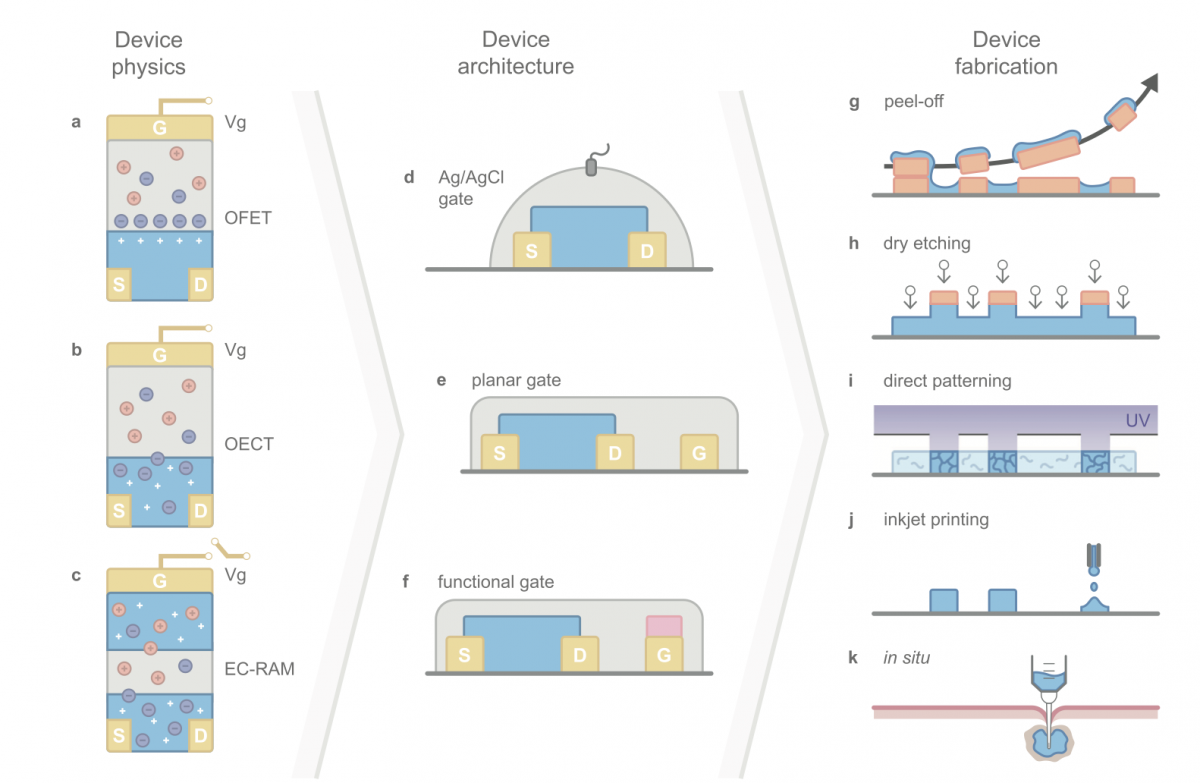
In recent years, our society has become increasingly connected. At the same time, wearable technologies, such as smartwatches and health trackers, have rapidly evolved, making it possible to monitor a wide range of physiological and behavioral signals. As the demand for more detailed and meaningful health data grows, the devices that collect and process this information must also become more advanced. This often requires more complex sensors and computing systems, as well as the use of machine learning to identify patterns and combine different types of data. To make these technologies truly practical for everyday use, devices must be small, energy-efficient, flexible, and ideally able to interact directly with the human body. A promising class of materials for this purpose is known as organic mixed ionic-electronic conductors (OMIECs). These materials can transport both ionic and electronic charges, which is a unique and valuable property. Biological systems, such as the human body, primarily rely on ions to transmit signals, while conventional electronics rely on electrons. OMIECs provide a bridge between these two worlds, enabling more natural and effective communication between electronic devices and biological systems. Devices called organic electrochemical transistors (OECTs) can be made using OMIECs. These transistors are particularly well-suited for wearable and bioelectronic applications because they operate at low power and can be designed to mimic how the body processes and transmits information. By taking inspiration from biological systems, this approach, often referred to as neuromorphic sensing and computing, has the potential to improve how devices interact with the body. Despite these advantages, OMIECs present important challenges. Traditional manufacturing techniques used for electronic devices were developed for inorganic materials and are not well-suited for these organic materials. While alternative fabrication methods exist, they often struggle with consistency, scalability, or the ability to integrate multiple OMIEC materials into a single device, an important requirement for more advanced systems. In this thesis, new fabrication techniques are developed to address these limitations. The approach is based on direct photopatterning, a process in which ultraviolet (UV) light is used to define structures in a material. When exposed to UV light, the material undergoes a chemical reaction that makes it insoluble, while unexposed regions can be removed using a solvent. This method is compatible with widely used manufacturing processes and does not require specialized equipment. As a result, it enables the creation of reproducible and scalable device structures. Importantly, it also allows different OMIEC materials to be patterned on the same substrate without compromising their performance. Finally, this work explores how OECTs perform in biological environments, which is essential for their use in real-world applications. One application studied is the measurement of ion concentrations in sweat. This type of sensing can provide valuable information about a person’s physiological state without the need for invasive procedures such as blood sampling. In addition, the stability of these devices in biological conditions is investigated, as long-term reliability is critical for their future use. Overall, this research contributes to the development of more practical and reliable bioelectronic devices. By improving the methods used to manufacture them, it helps pave the way for the next generation of wearable technologies that can seamlessly interact with the human body.
Learning-Based Calibration, Estimation and Stage Control for Electron Microscopy
How much can you learn from a handful of noisy images? For electron microscopes, the answer decides how sharp their images get and how steadily they can hold the object under study. An electron microscope can photograph individual atoms, an ability indispensable for new medicines, better batteries, and the chips in every phone. In the COVID-19 pandemic, electron microscopes revealed the structure of the spike protein within weeks and accelerated vaccine development. Yet these instruments cannot focus themselves. Keeping them sharp is the daily work of scarce, highly trained operators. The PhD research of Jilles van Hulst, at the Eindhoven University of Technology with microscope manufacturer Thermo Fisher Scientific, teaches the machines to do this themselves. Atomic resolution No microscope can show details smaller than the wavelength it uses, and visible light is thousands of times wider than an atom. Electrons offer a way out: a fast electron behaves as a quantum wave far smaller than an atom. If a light wave were stretched to the length of a football field, the electron wave would span just a few sheets of paper. Electrons are also electrically charged, so magnetic fields can act as lenses for them. However, a theorem from 1936 proves that these lenses always distort the image. Correctors have existed since 1998, but they add dozens of settings that drift and need constant retuning. Learning from a handful of images Retuning these settings is hard, and anyone who has focused an old camera by hand knows why. Looking at a single blurry photo, you cannot tell which way to turn the focus ring. Only once you turn it do you see where you were, and perfect focus is precisely the point where turning either way makes it worse. An electron microscope poses this puzzle not for one focus ring but for dozens of settings at once, and every image costs time and can damage the specimen. Van Hulst therefore trained artificial intelligence (AI) to get the most out of each image. The AI learns from a simulator, which can generate unlimited practice images, but a simulation is never exactly the real machine. So the full method also learns that difference during operation, from the few real images it collects. The symmetry of the blur around perfect focus is what pins that point down uniquely. The result is a microscope that calibrates itself in about twenty seconds, twice as accurately as the best automated methods. Standing still at the scale of atoms Seeing atoms also demands stillness. For a three-dimensional image, the specimen is tilted step by step while dozens of pictures are taken, and the point under study must stay in view. The stage carrying the specimen can move across millimeters, yet must hold the imaged point to within nanometers. The actuators that move the stage are imperfect, and no sensor measures where the specimen actually is. Van Hulst used the images that the microscope already records as the missing sensor. They reveal exactly how far the specimen has shifted, and a learning controller removes errors it has seen before. On an operational microscope this reached nanometer accuracy, up to ten times better than the existing approach. More knowledge from less data The common thread is a lesson from statistics: what you can learn from data depends on what you already know. Van Hulst therefore developed general mathematical methods that build known structure, such as physical laws, symmetries, and models of motion, into the learning itself, so that fewer measurements suffice. Together, these results bring the self-driving microscope closer. It tunes itself, holds its specimen steady, and collects data on its own, so that researchers can focus on the discoveries.
February 2026

Risk-based Motion Planning in Automated Vehicles
It is anticipated that there will be a long period where automated vehicles (AVs) and human road users share the same road network, with limited communication between them. As a result, AVs often operate with uncertain knowledge of their surroundings due to limitations in both sensing and estimation of the traffic scenario's current and future states. These limitations can be caused by factors such as noisy sensor data or lack of information about the intentions of other road users. Accounting for this uncertainty while designing motion planning and control algorithms for AVs is critical, as an AV may display hazardous behavior if it is overly confident in falsely estimated environment states or, contrarily, may act too cautiously when considering unnecessarily large safety margins in estimated states. Although safety regulations call for taking uncertainty into account, the right means to integrate uncertainty in motion planning has yet to be agreed upon. A promising way to account for uncertainty is through the concept of risk. Risk accounts for uncertainty in assessing safety by considering both the likelihood and severity of unsafe events, such as collisions. Research has shown that human drivers navigate traffic by trading off subjectively perceived risk against the potential rewards of reaching their destinations. Additionally, studies indicate that subjective risk tends to correlate with objective risk measures, while ethicists argue that risk can be used as a means to facilitate ethicality in road traffic by distributing risk fairly among road users. These relationships highlight the benefit of incorporating risk, as a proxy for uncertainty in safety, in motion planning algorithms. Incorporating risk in AV motion planning presents two main challenges. The first challenge is to develop a notion of risk that correctly incorporates an AV's uncertainty about the future motion of other road users, and that can be computed fast (and precisely) enough to be used in online (i.e., real-time) motion-planning algorithms. The second challenge is to develop an appropriate AV motion planning algorithm that incorporates risk and generates the desired AV behavior. This dissertation addresses both challenges by making five main contributions. First, we introduce an appropriate risk metric: the expected severity of a collision event. This metric, thus, is constituted of two terms, one accounting for the likelihood of a collision and another term considering the severity of a collision. Additionally, we investigate the AV behavior given optimization-based motion controllers that accommodate our risk metric. We find that a stochastic model predictive control (SMPC)-based motion planner adequately balances risk with travel efficiency in the presence of varying uncertainty. Second, to compute risk, we provide an computationally efficient (i.e., real-time computable) algorithm to estimate risk. Here, the focus lies on estimating the probability of collision (POC), as our risk metric reduces to a POC metric when the severity term is considered constant. Based on multi-circular shape approximations of the geometries of the AV and other road users, we present an algorithm that estimates the POC with good precision, and that is guaranteed not to under-approximate it. The algorithm is shown to execute significantly faster than standard Monte Carlo sampling. Further, we use the proposed algorithm within a SMPC-based motion planning strategy as a constraint and show that the SMPC generates smooth, reproducible trajectories while the controller deals with varying levels of uncertainty. Third, we extend our POC algorithm to risk estimation. Here, we propose a severity estimation method that allows us to consider different collision constellations, as literature shows that those are associated with different levels of harm to the passengers of vehicles. The resulting risk estimation algorithm leverages the advantages of the POC estimation algorithm, i.e., it is particularly suitable for optimization-based motion planning strategies, while allowing for the flexible integration of severity functions to represent different collision types. Fourth, we provide an extension of our risk metric to account for the risk from the individual perspective of each road user in the driving scene. Given a proposed SMPC-based motion planning strategy, our AVs behavior can be tuned such that it minimizes its own risk (egoistic perspective), the risk other road users face (altruistic perspective), and a balance of both (collective perspective). To evaluate safety and travel efficiency (i.e., reaching a desired destination in adequate time) for each of these risk metrics, we performed simulations on a database containing a wide variety of real-world and artificial traffic scenarios. The results show that a collective perspective balances the overall risk of all road users with the AV's travel efficiency in a favorable manner, and constitutes a suitable approach to facilitate ethicality in road traffic. Lastly, we use our proposed risk metric as part of the decision-making process on emergency maneuvers, i.e., emergency steering and emergency braking, for an AV designed to evade collisions with late-detected pedestrians. In simulations, we show that this metric outperforms deterministic risk estimation by choosing the appropriate evasive maneuver more frequently. In experimental testing, we verified the real-world applicability of this metric in an AV testbed designed for collision avoidance by having a pedestrian dummy walk out from a sight obstruction when the AV approaches. We find that risk is beneficial to deciding on accident avoidance maneuvers. The contributions introduced in this thesis show that risk, and thus uncertainty, can be systematically incorporated in AV algorithms for motion planning and decision-making. The proposed algorithms are computationally efficient for real-time optimization-based motion planning, navigating a fully automated vehicle smoothly through road traffic. Nevertheless, we also show that our risk metric is beneficial to the avoidance capabilities of low-automation safety systems. Furthermore, we show that risk-based AV behavior generation enables balancing the AV's interests in safety and travel efficiency for all road users, and thus, facilitates ethicality.