Monolithic processing of organic polymers for highly integrated circuits
Speaker

About this event
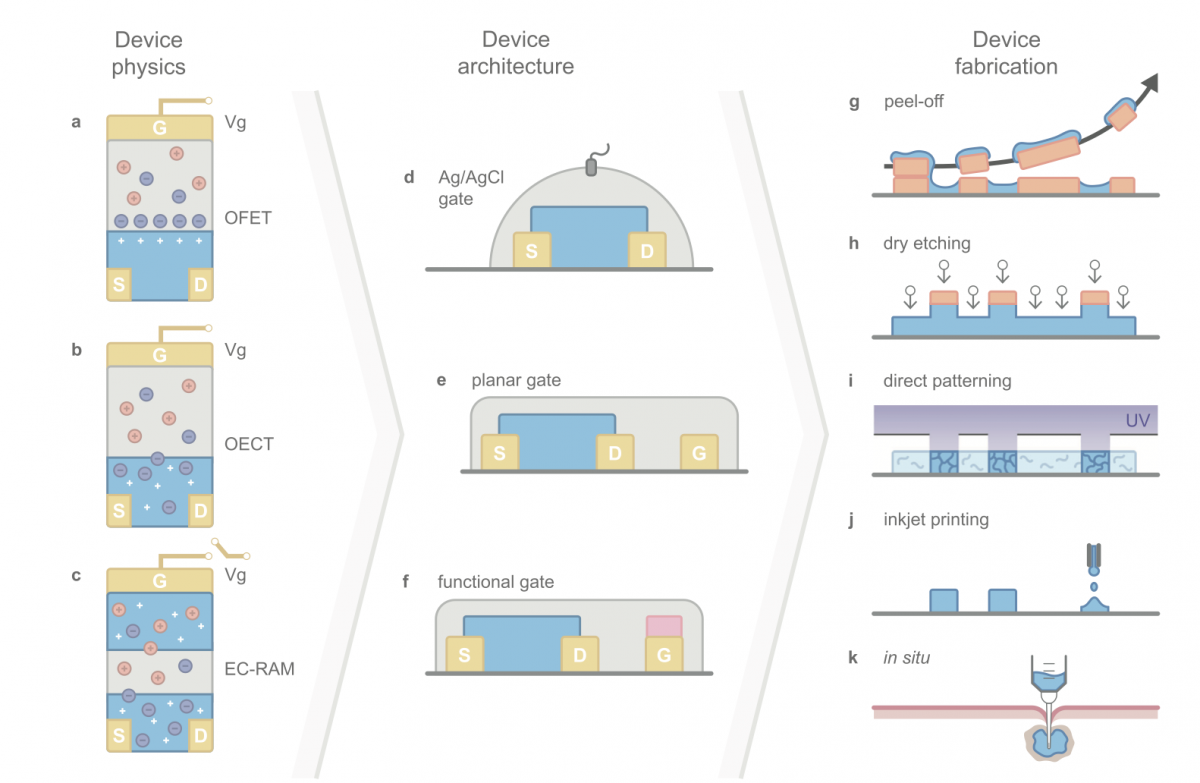
In recent years, our society has become increasingly connected. At the same time, wearable technologies, such as smartwatches and health trackers, have rapidly evolved, making it possible to monitor a wide range of physiological and behavioral signals. As the demand for more detailed and meaningful health data grows, the devices that collect and process this information must also become more advanced. This often requires more complex sensors and computing systems, as well as the use of machine learning to identify patterns and combine different types of data. To make these technologies truly practical for everyday use, devices must be small, energy-efficient, flexible, and ideally able to interact directly with the human body. A promising class of materials for this purpose is known as organic mixed ionic-electronic conductors (OMIECs). These materials can transport both ionic and electronic charges, which is a unique and valuable property. Biological systems, such as the human body, primarily rely on ions to transmit signals, while conventional electronics rely on electrons. OMIECs provide a bridge between these two worlds, enabling more natural and effective communication between electronic devices and biological systems. Devices called organic electrochemical transistors (OECTs) can be made using OMIECs. These transistors are particularly well-suited for wearable and bioelectronic applications because they operate at low power and can be designed to mimic how the body processes and transmits information. By taking inspiration from biological systems, this approach, often referred to as neuromorphic sensing and computing, has the potential to improve how devices interact with the body. Despite these advantages, OMIECs present important challenges. Traditional manufacturing techniques used for electronic devices were developed for inorganic materials and are not well-suited for these organic materials. While alternative fabrication methods exist, they often struggle with consistency, scalability, or the ability to integrate multiple OMIEC materials into a single device, an important requirement for more advanced systems. In this thesis, new fabrication techniques are developed to address these limitations. The approach is based on direct photopatterning, a process in which ultraviolet (UV) light is used to define structures in a material. When exposed to UV light, the material undergoes a chemical reaction that makes it insoluble, while unexposed regions can be removed using a solvent. This method is compatible with widely used manufacturing processes and does not require specialized equipment. As a result, it enables the creation of reproducible and scalable device structures. Importantly, it also allows different OMIEC materials to be patterned on the same substrate without compromising their performance. Finally, this work explores how OECTs perform in biological environments, which is essential for their use in real-world applications. One application studied is the measurement of ion concentrations in sweat. This type of sensing can provide valuable information about a person’s physiological state without the need for invasive procedures such as blood sampling. In addition, the stability of these devices in biological conditions is investigated, as long-term reliability is critical for their future use. Overall, this research contributes to the development of more practical and reliable bioelectronic devices. By improving the methods used to manufacture them, it helps pave the way for the next generation of wearable technologies that can seamlessly interact with the human body.
Host