
Events
Colloquia, thesis defenses, symposia and departmental events at the Department of Mechanical Engineering.
3 events Clear filters
September 2026
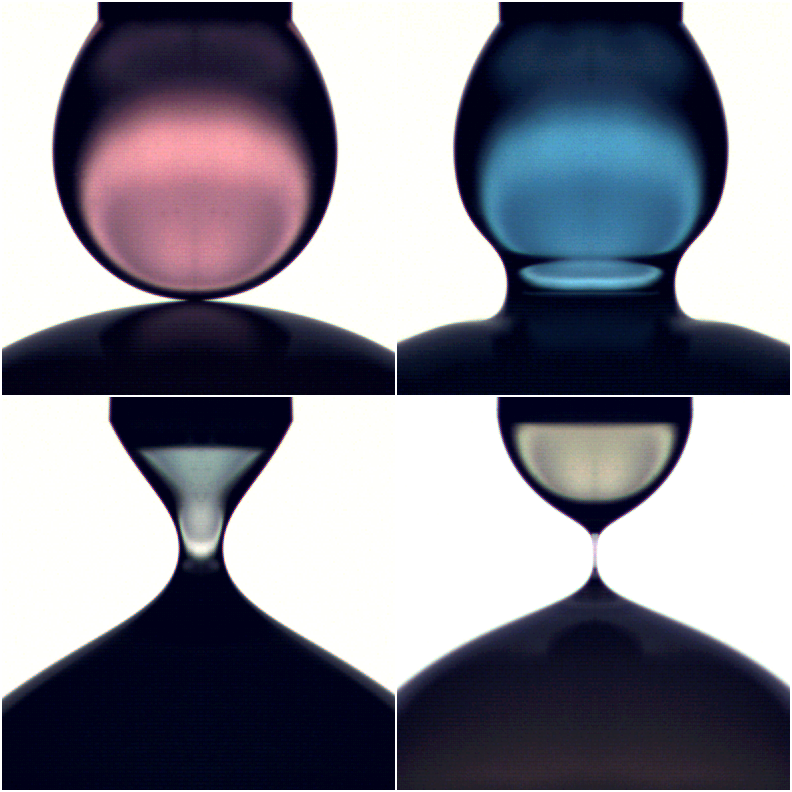
Dripping-onto-droplet capillary break-up
In general, Anselmo works on different topics in fluid mechanics/rheology, such as multiphase flows and interfacial problems, elastic and elasto-inertial turbulence, and the behaviour of elasto-viscoplastic materials, combining experiments+theory+simulations (https://cv.hal.science/anselmo-soeiro-pereira). He is also the head of the “Soft Matter Axis” at the CEMEF research institute and representative of the French Society of Rheology at the ESR.
Rheometry with Non-Rheometric Flows
Novel industrial rheometric approaches will be introduced for measuring viscoelasticity of a liquid as well as viscosity in complex flow fields. Modeling schemes based on energy dissipation rate will be introduced to establish the relationship between macroscopic flow parameters (torque, pressure drop, rotational speed, flow rate, deflection angle, etc.) and rheometric variables (shear stress, shear rate, shear strain, viscosity, shear modulus, etc.). Starting from the general flow quantification method for both rotational and pressure-driven flows, several application problems will be discussed to measure the viscosity as a function of shear rate and more importantly to measure the viscoelasticity in both linear and non-linear regimes. Example flow fields for viscoelasticity include (1) agitator systems with impellers and a vessel, (2) a viscometer-like system (a rotating object in a liquid pool), (3) general pressure-driven pipe flows.
Coupling Mechanics, Thermodynamics, and Transport in Interfacial Soft Materials
Most interfaces of natural, biomedical, and technological interest are formed by adsorbed compounds – such as proteins, polymers, lipids, or particles – that laterally interact, forming extensive microstructural networks that mechanically oppose flow and deformation. Aside from a surface tension, these so-called “complex interfaces” also exhibit a mechanical resistance to changes in area and shape, which bestow the interface with its own elastic and viscous properties. These mechanical properties can dictate the behavior of systems with large surface area to volume ratios (e.g., emulsions, foams, biological cells) and thin liquid films (e.g., tear film, lung surfactant film). In this seminar, I will first outline the fundamental principles and challenges in the field of interfacial rheology – namely, the coupling between thermodynamics, mechanics (rheology), and transport. I will then discuss the different experimental techniques available for characterizing complex interfaces and resolving this coupling, including those that are currently under development. Using illustrative examples from our research, I will demonstrate how interfacial rheology experiments are conducted, the types of quantitative data they provide, and how surface rheological properties can be tuned to optimize the function of complex interfacial systems.