Aerodynamic Performance of a Two-Bladed Rotor Under Large Inflow Misalignment
Speaker
Emile Ducornez
About this event
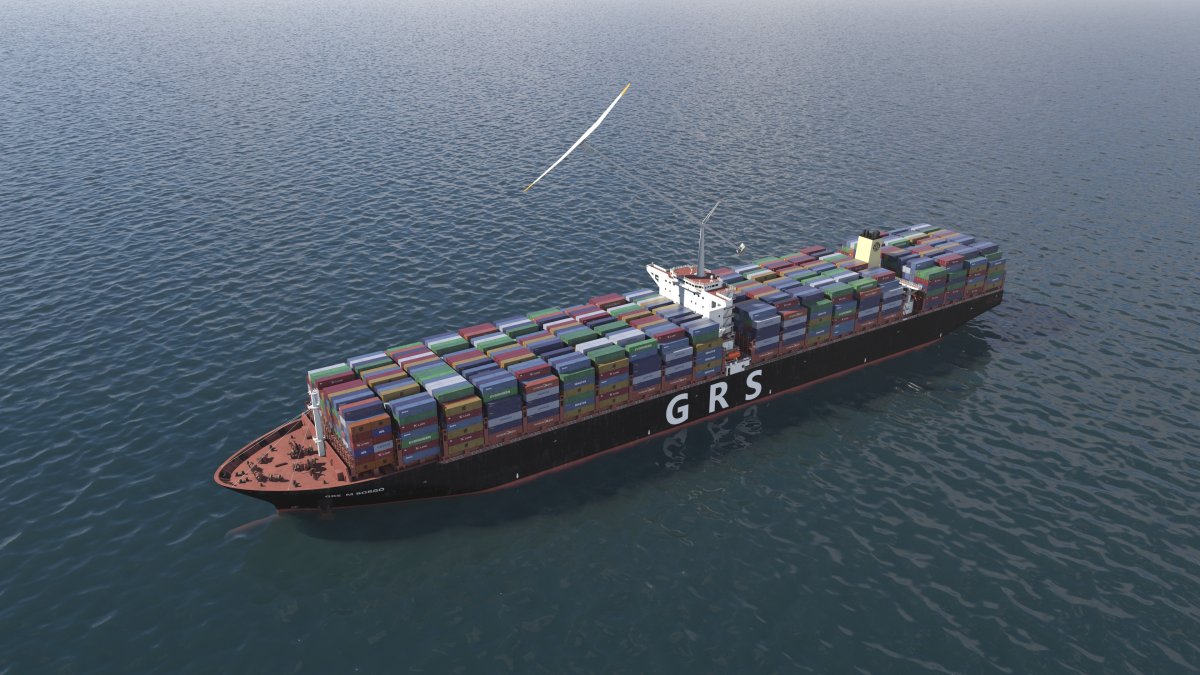
The TouchWind turbine has a tilted, teetering two-bladed rotor, originally developed for wind energy production. Besides extracting energy from the wind, the rotor experiences aerodynamic forces that can potentially contribute to vessel propulsion. This introduces the possibility of using the turbine to assist vessel propulsion while continuing to extract energy from the wind. To investigate this potential application, it is necessary to understand how rotor power and forward aerody-namic force vary with wind direction, turbine orientation, and tip-speed ratio (TSR). Calculating every possible operating point with a detailed aerodynamic model would be too time-consuming for repeated optimisation. This research therefore evaluates a numerical aerodynamic approach and develops surrogate predictions of the rotor’s response. The resulting predictive framework is subsequently explored in a vessel route-optimisation example to assess its potential contribution to wind-assisted propulsion. First, Blade Element Momentum (BEM) and cOnvecting LAgrangian Filaments (OLAF) simula- tions were compared with experimental data measured on a 1.2 m rotor. OLAF gave better overall agreement for the power coefficient CP , while BEM produced lower aggregate errors for the thrust coefficient CT . OLAF was selected for the following simulations because it better reproduced the measured power response over the investigated operating conditions and represents the skewed wake explicitly. The remaining thrust discrepancy is important because the forward aerodynamic force is needed for the intended application. The numerical modelling approach was then adapted to the 6 m rotor. An operating domain restricted by relative inflow angle was used to generate 200 OpenFAST/OLAF cases. Gaussian Process surrogate models were trained to predict CP and the forward-force coefficient Cf,forward from apparent inflow speed, apparent inflow angle, turbine yaw, and TSR. On 50 testing cases, the CP model achieved R2 = 0.983 and RMSE = 0.0129, while the forward-force coefficient model achieved R2 = 0.998 and RMSE = 0.0115. The sensitivity results also showed that the operating point giving the highest forward force does not necessarily give the highest power coefficient. The surrogate response was compared with selected measurements from the 6 m field turbine at an effective rotor–inflow angle near 30◦. Predicted thrust showed a similar dependence on TSR and broadly comparable magnitudes, while the maximum predicted power coefficient was lower than measured. Because the field conditions were uncontrolled and covered only a limited part of the operating domain, this comparison cannot establish full-scale accuracy across all conditions. Finally, the forward-force coefficient surrogate developed for the 6 m rotor was used in a vessel route-optimisation example. The predicted coefficient was converted into dimensional forward force using the swept area of an illustrative 48 m rotor. When the route was allowed to vary in response to the turbine contribution, the model predicted fuel reductions of 29.6% outbound and 46.3% on the return voyage. These savings depend on the force prediction, rotor scaling, and simplified vessel model, and have not yet been experimentally validated.
Host